 Increasingly we’re seeing communication channels expand and evolve in to more dynamic, interactive spaces. There’s been a gradual convergence between tradition and new media.
There are two fundamental changes I see:
- People are increasingly less responsive to traditional broadcast advertising
- Communication technology is developing at a very very fast rate
1. If an ad falls in the forest and no one notices, there is no ad.
In a traditional sense, you can define advertising as the science of creating and placing media that interrupts the consumer and prompts an action. Once upon a time this model was incredibly affective, ‘consumers’ had more time, less choice and so whoever shouted the loudest would win the argument. Not so anymore. Now we have less time and more choice, everyone is shouting at us at the top of their lungs why they’re the best and quite frankly it’s exasperating. I’m confused. I’m over-communicated. I’m cynical and having been exposed to traditional advertising all my life, I'm pretty savvy at avoiding it.
Seth agrees; "The interruption model is extremely effective when there's not an overflow of interruptions," Godin says. "But there's too much going on in our lives for us to enjoy being interrupted anymore."
That’s not to say that a new, innovative and incredible advert won’t grab attention but I think the challenge we have today is knowing how to shine amongst the clutter and appreciating that interruption is less exciting than interaction.
Its not a case of video killed the radio star; I don’t think it’s a matter of new media vs traditional media – it’s an evolution of our approach, the channels we use and an appreciation that the proliferation of media has changed the way in which people engage with content (remember that now consumer media consumption across channels leads to virtual days exceeding 24 hours)!
I’ve worked in agencies where this shift is emphasised to clients and yet in many cases, traditional media forms such as television remain the biggest investment, even if it’s not the best choice. One obstacle is lack of understanding of new media, followed by company inertia, another big obstacle is finding reliable metric models of these new tools and how a lot of marketers are still trying to retrofit those applied to traditional media.
Of course, the fact that people are less responsive to being shouted at also provides a great argument for a popular space at the moment, social media, where brands and people can have a dialogue. Personally whilst I think social media is a fantastic opportunity for marketers, brands and consumers alike, I also believe the facets of this space are really the beginning of things to come.
Our challenge as marketers is to find what might surprise, cut through, engage, entertain, add value and start conversations whilst using the right media to facilitate it in an increasingly fragmented landscape where ultimately the consumer's in control.
2. Communication technology is developing at a very very fast rate
If we look over the last century and examine the rate of technological growth its incredible to review the rate at which it has developed. We can fly, travel underwater, go to space, access the world wide web, we can see and talk to people on the other side of the world instantaneously, share still images by the click of a button, we can even carry our wallet, bank account, a GPS map, social network, search facility, computer game and telephone in our back pocket. Change will never be this slow again.
What I find very exciting is how traditional communication platforms are also progressing and moving in to the digital realm through these advances in technology and the internet. Some examples below:
TV channels are streaming catch-up TV online, TV channels are launching solely online, they’re integrating with social media (great post on this here), TV has got smarter, more relevant and started to allow for interaction at the push of a button. This I see only progressing.
Print: Newspapers and Magazines have been quite challenged lately and whilst there is seemingly a decline in the medium, the product remains strong. It is the means through which stories are distributed that are undergoing a rapid development. We’re already seeing print complemented with online articles/blogs/Twitter accounts. But this is just a glimpse of what we have to come, see the e-paper business and the likes of Amazon Kindles and Apple’s iPad to get an idea of what we might be reading stories from in the future.
And of course, not to mention, Outdoor Display which now commonly features interactive digital billboards, QR codes (personally not as exciting, but clever nonetheless), can create augmented realities, interactive window displays and not to mention feature hologram technology.
So to conclude, new technology allows for a much needed change of approach and engagement between brands and people. There’s more breadth, room for innovation and opportunities to do something amazing and interactive with people rather than just broadcasting a one-way message.
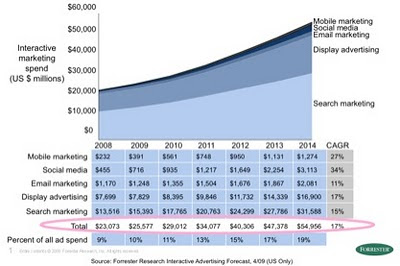
Forrester unsurprisingly has predicted a growth in interactive advertising and among the interactive channels, Forrester sees social media and mobile marketing spending expanding significantly between 2009 and 2014, with social media jumping by 34% on a compounded annual basis and mobile marketing increasing by 27%.
But these are young channels, at least as compared with relatively mature interactive mediums such as e-mail, display advertising and search which are also seeing a change.
I think it naïve to presume that interactive advertising solely rests within what some perceive as “Online / Digital”, we need to remember that traditional channels are becoming increasingly digitalised, technology is changing and whilst interaction is important and digital may facilitate it - you still need to be a brand that people want to interact with.


