Pages

Showing posts with label Digital. Show all posts

03 December, 2013

what do you mean "you don't have a phone?!"


When I was in Austria I managed to lose my hard-drive in transit along with my mobile phone charger who was in bed with him. Then my spare phone charger didn't make it to NYC. I figured this was a message for me to have some time out and face another challenge. Being phone-less.

Its not often I lose 'stuff' but it does happen to travellers occasionally and I found treating the missing items as the Buddhist monks do their mandalas which they spend so much dedicated time and discipline towards creating before destroying and burning in prayer as beautiful way of letting go of the fact that the edited images, videos, books, music, poetry and films collated from a huge part of my travels have gone. I hope I have as much fun starting again :)

I have however found a lack of mobile connection to be a blessing in disguise and a rather interesting social experiment. I have been based in a very progressive city, New York City and whilst reconnecting with old friends here and making new ones I realise not having a phone has presented a number of challenges yet equally massive perks. And of course, like many periods of time I've had abstaining from anything, I find myself a little subjected to social ridicule and "no waaaays". Nothing new for me I suppose.

Here is how, quite simply, I tackle not having a mobile phone in a major city where so many are addicted to their devices.
  • Noting down directions, drawing mini maps, using a diary, wearing a watch, a compass would be cool too (no joke!)
  • Pocket subway map
  • More time reading books and writing 
  • Emails/skype instead of texting/calling
After watching the video above, I must admit that I am happy to have surrendered having a mobile for the last month in the USA.  I'm sure I've done my mind some favours and given myself a greater opportunity to connect with the present while probably spending more time working out which way I need to go.

Plus, I do wonder what the impact of mobile phone signals can have on our electromagnetic field and sense of balance... inner granny moment.

06 May, 2011

where do you think most of google's searches come from?


Every day, people come to Google Search to ask questions. Through Google, questions become answers, and answers lead to the next set of questions. These people come from around the world and all walks of life, speaking hundreds of different languages, typing in search queries every single day. Today Google share the Search Globe, a new visual display representing one day of Google searches around the world—visualizing the curiosity of people around the globe.

The Search Globe visualizes searches from one day, and shows the language of the majority of queries in an area in different colors. You’ll see a bright landscape of queries across Europe, and parts of Asia for instance, but unfortunately we see many fewer searches from parts of the world lacking Internet access—and often electricity as well—like Africa.

09 March, 2011

UNICEF: Scan & Help

If a person in a developing country could reach out to you directly and ask for your help, wouldn’t you give it to them? That’s the premise behind SCAN AND HELP, a display advertising campaign that uses Mobile Tags to connect people in the first world with people in developing countries.

Scanning the tag will launch an augmented reality application that will let users explore the environment of the person on the poster (who may be a relief worker or aid recipient).
via: PSFK

Unicef went a step further by also integrating deals with sponsors/partner discounts offering discounts at retailers in catalogues (using mobile tagging) and as part of the checkout process, users would be able to donate the money they saved to a campaign or in store where they would have the option to donate then or at checkout. Tags would be integrated in to the retailer’s POS system so the cashier could scan the Mobile Tag and log the donation as easily as scanning a traditional barcode.

I've often thought this a sweet spot for charity organisations, we know people spend to feel good, we also know that altruism makes you feel good too, lets connect those experiences.


28 February, 2011

great digital goodness

Everyday we continually witness the evolution of awesome technology enabled communication. Sometimes I struggle to keep up. Which is why I've been lazy and given you a brief installment :)

Google’s Christchurch Person Finder
Technology is coming to the aid of those affected by last night's earthquake in Christchurch. Within hours of the devastating 6.3-magnitude quake, Google's "emergency response team" had set up a simple web tool to help people request and post information about missing friends and relatives. The person finder, embedded below, already has 4300 records of both missing people and those who are letting their terrified relatives know that they're safe.

Set up by New Zealand's Earthquake Commission, the simple website lets users tweet to #christchurch, or #eqnz or #ChristchurchQuake to give information about people who are trapped or where damaged buildings and even payphones are located. The site also lists reports as they come in from residents including live pictures and where working ATMs can still be found.

Oscars streamed live, for a small fee of course.

Just thought it topical to share the latest innovation from the Oscars (award show starting in one hour) check out the latest socialisation of traditional media via their live streaming of the awards ceremony, behind the scenes, twitter feeds and other bells and whistles.

HOME a film by Yann Arthus-Bertrand: Something for you to watch tonight

HOME has been conceived to take a message of mobilization out to every human being. When it comes to environmental policies such as climate change legislation, land conservation, or bans on oil drilling, a grasp of the science and economics behind the issues might seem essential. But polls show that people tend to base their views on ‘gut’ feelings and personal philosophies. As we know in advertising, targeting the heart, therefore, might sway minds when numbers can't.

HOME is a carbon offset movie streaming free on YouTube: http://www.youtube.com/watch?v=jqxENMKaeCU


Kinect childrens imagination (like what I did there?)
Chris O’Shea is a Kinect Hack. He’s brought the imagination of children to life through storytelling, performance and technology in a bid to encourage children to get excited about storytelling.

Little Magic Stories from Chris O'Shea on Vimeo.

Very cute demonstration of creative utility.

13 September, 2010

What does The Wire have in common with advertising?


I was watching The Wire (Season 3) last night when an interesting point was flagged. Season 3 is all about change, it deals with how the drug game has to evolve as distribution channels ("The Projects") are demolished, the importance of product and efficient policing to keep to a commitment on crime numbers. Its all very political and man do I love it.

The brutality at Police Headquarters continues as Rawls and Commissioner Burrell terrorise Department Commanders over their failure to reign in the city's crime stats. In one scene in particular, one of the Baltimore's Police Sergeants gets verbally torn apart by Major Rawls after allowing his department to treat a number of thefts in a small locale with separate teams, shifting responsibility by fragmented cases, because apparently some thefts were corporate premises rather than retail outlets and individual homes albeit all on the same street resulting in poor efficiency and one really narked Commissioner.

I thought this a great metaphor for how advertising is often treated. A lot of agencies will separate by media such as TV, OOH/Print and Digital etc. which makes a lot of sense from a media booking standpoint but the irony being that at least from a strategic messaging standpoint, they all play a role in interweaving the overall campaign objective i.e. we're all working the same street.

Now I’m no expert in this, but a part of me feels that given the proliferation of media which moves away from static to interactive, we should all understand how each channel can be optimised and manage it collectively rather than in silo sharing learnings along the way. That means everything, from media, creative and production etc. or risk getting our asses whipped by the likes of Major Rawls in the not so distant future.

16 July, 2010

philosophical about the interwebs


I realised today that I have been blogging in some shape or form for 12 years now (obviously not always under jectaspecta) and whilst time has passed me by, dial up has evolved to broadband, delayed to instant and private to public - I have grown up, to some extent and now in retrospect query my relationship with what has almost converged to become my virtual butler.

Nicholas Carr is a writer who commentates on how Information Technology is integrated in to our lives as a standardised practice. More recently he has been examining the cognitive and cultural consequences the internet has been having on our minds.

"I'm not thinking the way I used to think," Carr tells us. "I feel it most strongly when I'm reading." He relates how he gets fidgety with a long text. Like others, he suspects that the Internet has destroyed his ability to read deeply. "My brain," he writes, "wasn't just drifting. It was hungry. It was demanding to be fed the way the Net fed it."

The history of reading is an interesting one. Words were once written without spaces and punctuation, they required a lot of attention to understand. Books were read aloud and shared with those who could not read (to their amazement). Readers slowly evolved to become accustomed to ignoring the sounds around them (going against our nature of alertness) and thus the deep thinker was born with cognitive ability to concentrate on the written word. Following the advent of the printing press, in a virtuous feedback loop, the public became more literate as more books circulated. How our minds adapt. Note: I bet you won't read all of this.

Carr believes that encouraged by the frenetic, fragmented, hyperlinked web, our skills in deep thought are now diminishing. We are becoming easily distracted, pay less attention to books or articles for sustained length and our minds have become data processing machines.

Carr's assertions have increasingly become a fact of accepted knowledge: that our addiction to the web and computers is affecting the way we think. That is, our capability for "deep thinking", is limited without the time to process information and draw our own conclusions.

Scarily, this concept has been shown to have significant foundations amongst academic performance in schools, studies reveal that home computers have "modest but statistically significant negative impacts" on academic performance as measured by math and reading test scores. In addition: "The introduction of high-speed internet service is similarly associated with significantly lower math and reading test scores in the middle grades." Worse yet, "the introduction of broadband internet is associated with widening racial and socioeconomic achievement gaps." Attempts to close the "digital divide" by, for example, subsidizing PC purchases may actually end up widening the divide between rich and poor in academic performance. And we thought computers promoted development.

Few concepts have spread as rapidly as the ‘digital divide’ and with it, the hope of using modern IT to promote development. Groups from the United Nations to local governments, and private companies have seized upon the hope that the use of IT could enable even the poorest of developing nations to “leapfrog” their problems of development such as poverty, illiteracy, disease, unemployment, hunger, corruption, and social inequalities so as to move rapidly into the modern Information Age.

We know little about the factors that make for effectiveness or ineffectiveness of grassroots IT projects in developing nations. Thus, critics can point out that the cost of creating a working Internet connection in a developing nation is the same as that of providing immunization against six fatal childhood diseases to thousands of children. Others have argued that the introduction of ICT’s into communities otherwise unchanged will merely heighten existing inequalities. Do we really know?

Is knowledge and wisdom based on things like reason, experience, perception? Or is it now a commodity, or data, that can be applied for a given situation. Has it become devoid of humanity? Of deeper processing? Have we become lazy because there is a machine that can offer an answer quicker than we can ask it? Does that knowledge become less significant because of its accessibility and transparency?

Not only is it just the way that we garner information that has changed but also what we do with it. Increasingly we syndicate this data via social networks: "web-driven speaking tools that reduce our own communication to data piles, stacked with quick, surface-level proclamations".

And while we may be sociable online, the social aspect of those networks is only distinguishable by the ability to connect people to one another in the strictest internet sense - not physically scarcely audibly, but almost in abstract. In the end, as we place our focus in to the screen, we are facing only what we've directed these machines to do - that is, so to speak, we are facing ourselves.

Forgive what may come across as a geek staring at the stars but it is, essentially, the virtual manifestation of our intentions. Its a perpetual narcissistic feedback loop of enclosed interactivity. Its the social network of our online persona, controlled by our offline selves communicated via a small piece of equipment shining a rectangle of ironic interaction. Confused? I think I am too. This requires deep thought.

Simply, we are drawn to an interface by its proximity and emptiness that it begs us to fill. Its the blank canvas that allows for an aggregation of content which gives us a unique opportunity to make it our own, our individualistic way. Our fingers encounter something tactile (sometimes greasy) but in reality the image is always light years away at a unique distance that can only be described as unbridgeable by the body.

What we are communicating is a mirror of ourselves in a highly pix-elated form, existing only as far away as the fingertip to keypad and yet equally, not anywhere at all.

Perhaps we are in danger of becoming simply the same surface-level information that we have become slowly programmed to gather.

Has IT made us smarter and less wiser? Should we change the way we gather information or the way we communicate it?

Is it time to get an iPad?

21 May, 2010

australian digital landscape

Recently on my visit to meet the remainder of my team in San Fransisco, I presented an update on the digital landscape in Australia. It was a brilliant exercise and a great opportunity for everyone to share their thoughts, qualms and questions on the subject.

I've boiled it down a little for the purposes of my blog.

You have a voice here - feel free to use it. Even if you just want to tell me it sucks and digital smells.

25 April, 2010

Augmented Flashmob in Amsterdam


Amsterdam residents got together at Dam Square yesterday for the first ever augmented reality flashmob. Darth Vader, The Beatles, Superman and various other awesome characters were in attendance.

Love the concept but its just so bizarre to see it in practice. There's no real interaction between the attendees as they're all engrossed with the interfaces of their mobiles.

This dude summed it up nicely ;)

13 April, 2010

The Internet of Things


"The Internet of Things" talks to how the internet has become a nervous system to our planet which can transform data and glean wisdom to create efficiencies in our every day lives.

I wonder what this means? Will humankind become lazy? Will this give us an opportunity to focus on different things such as innovation and creation?

(Thanks Conrad)

11 April, 2010

IBM Colour Sensitive Interactive Billboard

Color Sensitive Interactive Billboard from milton cj on Vimeo.
Interesting use of digital signage. One might even call it 'smart'...

(via Fubiz)

04 April, 2010

Wireless communications

Its insane how rapid mobile is evolving. Mobile phones have fast become a phenomenon. They're no longer a medium for making voice calls but a platform to communicate in a ubiquitous world.

They're a tool that keeps you constantly in the present. They wake you up in the morning, facilitate gaming, stream movies, music, connect you to your proverbial social sites such as Twitter, Facebook and Foursquare. Furthermore, mobile commerce is evolving from early innovation to mainstream adoption.

Current mobile trends:
  • - Mobile will soon be able to stream movie content (via iPhone)
  • - iPhone and Android are becoming a platform of choice for developers
  • - iPad follows closely behind (iPad is mostly attractive to iPhone users)
  • - 73% of Android users are guys
  • - 78% of iPod touch users are younger than 25
  • - iPod touch users love apps and download an average of 12 a month, spending 100 minutes a day using them (37% more apps than iPhone and Android users)
  • - When it comes to solely paid apps, iPhone users lead the pack (half of them buy at least one app a month)

  • MOCOM2020 is an open think tank about mobile media worldwide. Their goal is "to develop a visualized vision of the future of mobile media in the year 2020". They also track the latest buzz on mobile communications.


    AdMob serve ads for more than 15,000 mobile Web sites and applications around the world (and stores and analyses the data from every ad request, impression, and click) and offer a snapshot of its data to provide insight into trends in the mobile ecosystem.

    Recently they ran a survey to AdMob publishers to understand how they are thinking about cross-platform development. The key takeaway from the survey is that 47% of publishers said they plan on developing on more than one platform in the next 6 months. Among those who plan on developing for another platform, Android was the top choice (caveat Blackberry is not included in the survey).

    'In the same vein' they published results of a survey from Appcelerator which measured mobile developer interest on different platforms and found a similar strong interest in Android:

    I predict in terms of the breadth of offering and functionality, mobile phone users are going to see their pocket device become increasingly dynamic and depended on in the years to come.

    The challenge for brands is how they will facilitate this, using relevant content to work within a world where the primacy of once-virtual communication is transforming as, increasingly, the virtual and the real combine.

    28 March, 2010

    Is the digital revolution sustainable?

    “There are potentially large and early gains from better utilization of known technologies, goods and services…” Ross Garnaut, The Garnaut Climate Change Review, Final Report.


    So in my previous post, I made some predictions about the media landscape of the future, of how the convergence between the 'traditional' and the 'new' will progress through the proliferation of media (from an advertisers perspective).

    As someone who cares about the environment, its important to realise what this 'digital revolution' will translate to if information and communication technology (ICT) doesn't evolve quick enough and companies continue to have an incumbent approach to sustainability. Hence this post, from a Greenie's perspective.

    There's no denying that digital presents great opportunity to limit footprint but its important to remember that whilst there's an element of intangibility, digital data needs to be stored somewhere in the real world (aka 'Cloud').

    Presuming the over reliance on non-renewable energy continues, what will be the impact within ICT?

    Well at present only 25% of the world is connected to the internet. This is due to change, Africa is one of the latest continents to become 'connected' and adoption is going to continue to grow exponentially in the coming years.

    There are more than one billion PCs and laptops currently in use, and that number is expected to grow to four billion by 2020 - that's an increase of 400% in ten years. A lot of people perceive the internet as a given or a right, but we must remind ourselves in the Western world- we still represent a minority.

    ICT emissions are the same as the Aviation industry and yet for some reason ICT is largely ignored in the debate on emissions (even though its predicted to increase to 6% by 2020 - equal to the output of the Steal Industry). Is it because we can't see it? We certainly think about it when printing on paper or catching a plane. In one year it is estimated that an average server produces as much CO2 emissions as a family car... To put this in to perspective; Google is said to have somewhere between 700,000 to 1 million servers.

    Lets look at 'emerging media' Google Search in more detail...

    “The global search market continues to grow at an extraordinary rate, with both highly developed and emerging markets contributing to the strong growth worldwide,” said Jack Flanagan, comScore executive vice president. “Search is clearly becoming a more ubiquitous behavior among Internet users that drives navigation not only directly from search engines but also within sites and across networks. If you equate the advancement of search with the ability of humans to cultivate information, then the world is rapidly becoming a more knowledgeable ecosystem.”

    What does that mean in terms of emissions? Well according to Google, one Google search is equivalent to about 0.2 grams of CO2. In 2009 there were 2.9 million searches conducted per minute by internet users over 15 according to commScore (an annual growth of over 40%) and Google accounted for 66.8% of these. Using my incredible mental arithmetic here: that's 1,937,200 Google searches per minute which according to them; equates to nearly three weeks worth of the average US households electricity consumption. That - all in one minute!

    Source: Google blog

    Within the advertising industry we've seen more content rich websites, 3D gaming, the advent of augmented realities and witnessed the progression of the ubur connected individual through social networks. This (much to my excitement) a demonstration of the breadth and evolution of digital communication and yet, often overlooked, consequently puts greater demands on data storage and energy use.

    “Data centres are among the most energy-intensive facilities imaginable,” says Evan Mills, a scientist at the Lawrence Berkeley National Laboratory in California. Banks of servers storing billions of web pages require power and lots of it! This is obviously not limited to search but across the internet infrastructure, its massive, behemoth and growing really really really fast.

    Needless to say digital technologies do much to also limit carbon output, digital content and tools enable us to do many things quicker, with better quality, using fewer resources. But we must also consider the increase in e-waste and electricity consumption created as a consequence to the digital revolution. The challenge is to improve the environmental sustainability of the digital technologies we use and to use technology effectively to reduce resource consumption at the same time.

    07 March, 2010

    I’ve sent the future and its… Digital?

    Increasingly we’re seeing communication channels expand and evolve in to more dynamic, interactive spaces. There’s been a gradual convergence between tradition and new media.

    There are two fundamental changes I see:

    1. People are increasingly less responsive to traditional broadcast advertising
    2. Communication technology is developing at a very very fast rate

    1. If an ad falls in the forest and no one notices, there is no ad.

    In a traditional sense, you can define advertising as the science of creating and placing media that interrupts the consumer and prompts an action. Once upon a time this model was incredibly affective, ‘consumers’ had more time, less choice and so whoever shouted the loudest would win the argument. Not so anymore. Now we have less time and more choice, everyone is shouting at us at the top of their lungs why they’re the best and quite frankly it’s exasperating. I’m confused. I’m over-communicated. I’m cynical and having been exposed to traditional advertising all my life, I'm pretty savvy at avoiding it.

    Seth agrees; "The interruption model is extremely effective when there's not an overflow of interruptions," Godin says. "But there's too much going on in our lives for us to enjoy being interrupted anymore."

    That’s not to say that a new, innovative and incredible advert won’t grab attention but I think the challenge we have today is knowing how to shine amongst the clutter and appreciating that interruption is less exciting than interaction.

    Its not a case of video killed the radio star; I don’t think it’s a matter of new media vs traditional media – it’s an evolution of our approach, the channels we use and an appreciation that the proliferation of media has changed the way in which people engage with content (remember that now consumer media consumption across channels leads to virtual days exceeding 24 hours)!

    I’ve worked in agencies where this shift is emphasised to clients and yet in many cases, traditional media forms such as television remain the biggest investment, even if it’s not the best choice. One obstacle is lack of understanding of new media, followed by company inertia, another big obstacle is finding reliable metric models of these new tools and how a lot of marketers are still trying to retrofit those applied to traditional media.

    Of course, the fact that people are less responsive to being shouted at also provides a great argument for a popular space at the moment, social media, where brands and people can have a dialogue. Personally whilst I think social media is a fantastic opportunity for marketers, brands and consumers alike, I also believe the facets of this space are really the beginning of things to come.

    Our challenge as marketers is to find what might surprise, cut through, engage, entertain, add value and start conversations whilst using the right media to facilitate it in an increasingly fragmented landscape where ultimately the consumer's in control.

    2. Communication technology is developing at a very very fast rate

    If we look over the last century and examine the rate of technological growth its incredible to review the rate at which it has developed. We can fly, travel underwater, go to space, access the world wide web, we can see and talk to people on the other side of the world instantaneously, share still images by the click of a button, we can even carry our wallet, bank account, a GPS map, social network, search facility, computer game and telephone in our back pocket. Change will never be this slow again.

    What I find very exciting is how traditional communication platforms are also progressing and moving in to the digital realm through these advances in technology and the internet. Some examples below:

    TV channels are streaming catch-up TV online, TV channels are launching solely online, they’re integrating with social media (great post on this here), TV has got smarter, more relevant and started to allow for interaction at the push of a button. This I see only progressing.

    Print: Newspapers and Magazines have been quite challenged lately and whilst there is seemingly a decline in the medium, the product remains strong. It is the means through which stories are distributed that are undergoing a rapid development. We’re already seeing print complemented with online articles/blogs/Twitter accounts. But this is just a glimpse of what we have to come, see the e-paper business and the likes of Amazon Kindles and Apple’s iPad to get an idea of what we might be reading stories from in the future.

    And of course, not to mention, Outdoor Display which now commonly features interactive digital billboards, QR codes (personally not as exciting, but clever nonetheless), can create augmented realities, interactive window displays and not to mention feature hologram technology.

    So to conclude, new technology allows for a much needed change of approach and engagement between brands and people. There’s more breadth, room for innovation and opportunities to do something amazing and interactive with people rather than just broadcasting a one-way message.
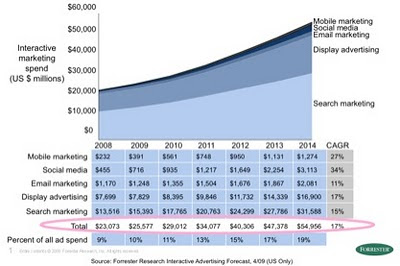
    Forrester unsurprisingly has predicted a growth in interactive advertising and among the interactive channels, Forrester sees social media and mobile marketing spending expanding significantly between 2009 and 2014, with social media jumping by 34% on a compounded annual basis and mobile marketing increasing by 27%.

    But these are young channels, at least as compared with relatively mature interactive mediums such as e-mail, display advertising and search which are also seeing a change.

    I think it naïve to presume that interactive advertising solely rests within what some perceive as “Online / Digital”, we need to remember that traditional channels are becoming increasingly digitalised, technology is changing and whilst interaction is important and digital may facilitate it - you still need to be a brand that people want to interact with.

    08 August, 2009

    Wiring a web for global good

    Its amazing the opportunities we have right now, we really are in the day and age of true interconnectedness. Where we can instantly inform and amplify, share and respond to digital content.

    I think this is something we're going to see more of. In countries where oppression is rife, where media is biased and where access is limited we're going to see more harnessing of social media as a tool to create awareness. Action Aid Australia have made a very forward thinking move with Project TOTO in recruiting a blogger to teach people from developing countries how to use these tools so that people can have insight into the realities they face day to day.

    Gorgon Brown talks to this very enthusiastically at his talk at TED last month.

    Related Posts Plugin for WordPress, Blogger...