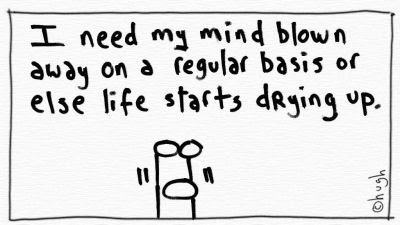
I realised today that I have been blogging in some shape or form for 12 years now (obviously not always under jectaspecta) and whilst time has passed me by, dial up has evolved to broadband, delayed to instant and private to public - I have grown up, to some extent and now in retrospect query my relationship with what has almost converged to become my virtual butler.
Nicholas Carr is a writer who commentates on how Information Technology is integrated in to our lives as a standardised practice. More recently he has been examining the cognitive and cultural consequences the internet has been having on our minds.
"I'm not thinking the way I used to think," Carr tells us. "I feel it most strongly when I'm reading." He relates how he gets fidgety with a long text. Like others, he suspects that the Internet has destroyed his ability to read deeply. "My brain," he writes, "wasn't just drifting. It was hungry. It was demanding to be fed the way the Net fed it."
The history of reading is an interesting one. Words were once written without spaces and punctuation, they required a lot of attention to understand. Books were read aloud and shared with those who could not read (to their amazement). Readers slowly evolved to become accustomed to ignoring the sounds around them (going against our nature of alertness) and thus the deep thinker was born with cognitive ability to concentrate on the written word. Following the advent of the printing press, in a virtuous feedback loop, the public became more literate as more books circulated. How our minds adapt. Note: I bet you won't read all of this.
Carr believes that encouraged by the frenetic, fragmented, hyperlinked web, our skills in deep thought are now diminishing. We are becoming easily distracted, pay less attention to books or articles for sustained length and our minds have become data processing machines.
Carr's assertions have increasingly become a fact of accepted knowledge: that our addiction to the web and computers is affecting the way we think. That is, our capability for "deep thinking", is limited without the time to process information and draw our own conclusions.
Scarily, this concept has been shown to have significant foundations amongst academic performance in schools, studies reveal that home computers have "modest but statistically significant negative impacts" on academic performance as measured by math and reading test scores. In addition: "The introduction of high-speed internet service is similarly associated with significantly lower math and reading test scores in the middle grades." Worse yet, "the introduction of broadband internet is associated with widening racial and socioeconomic achievement gaps." Attempts to close the "digital divide" by, for example, subsidizing PC purchases may actually end up widening the divide between rich and poor in academic performance. And we thought computers promoted development.
Few concepts have spread as rapidly as the ‘digital divide’ and with it, the hope of using modern IT to promote development. Groups from the United Nations to local governments, and private companies have seized upon the hope that the use of IT could enable even the poorest of developing nations to “leapfrog” their problems of development such as poverty, illiteracy, disease, unemployment, hunger, corruption, and social inequalities so as to move rapidly into the modern Information Age.
We know little about the factors that make for effectiveness or ineffectiveness of grassroots IT projects in developing nations. Thus, critics can point out that the cost of creating a working Internet connection in a developing nation is the same as that of providing immunization against six fatal childhood diseases to thousands of children. Others have argued that the introduction of ICT’s into communities otherwise unchanged will merely heighten existing inequalities. Do we really know?
Is knowledge and wisdom based on things like reason, experience, perception? Or is it now a commodity, or data, that can be applied for a given situation. Has it become devoid of humanity? Of deeper processing? Have we become lazy because there is a machine that can offer an answer quicker than we can ask it? Does that knowledge become less significant because of its accessibility and transparency?
Not only is it just the way that we garner information that has changed but also what we do with it. Increasingly we syndicate this data via social networks: "web-driven speaking tools that reduce our own communication to data piles, stacked with quick, surface-level proclamations".
And while we may be sociable online, the social aspect of those networks is only distinguishable by the ability to connect people to one another in the strictest internet sense - not physically scarcely audibly, but almost in abstract. In the end, as we place our focus in to the screen, we are facing only what we've directed these machines to do - that is, so to speak, we are facing ourselves.
Forgive what may come across as a geek staring at the stars but it is, essentially, the virtual manifestation of our intentions. Its a perpetual narcissistic feedback loop of enclosed interactivity. Its the social network of our online persona, controlled by our offline selves communicated via a small piece of equipment shining a rectangle of ironic interaction. Confused? I think I am too. This requires deep thought.
Simply, we are drawn to an interface by its proximity and emptiness that it begs us to fill. Its the blank canvas that allows for an aggregation of content which gives us a unique opportunity to make it our own, our individualistic way. Our fingers encounter something tactile (sometimes greasy) but in reality the image is always light years away at a unique distance that can only be described as unbridgeable by the body.
What we are communicating is a mirror of ourselves in a highly pix-elated form, existing only as far away as the fingertip to keypad and yet equally, not anywhere at all.
Perhaps we are in danger of becoming simply the same surface-level information that we have become slowly programmed to gather.
Has IT made us smarter and less wiser? Should we change the way we gather information or the way we communicate it?
Is it time to get an iPad?


